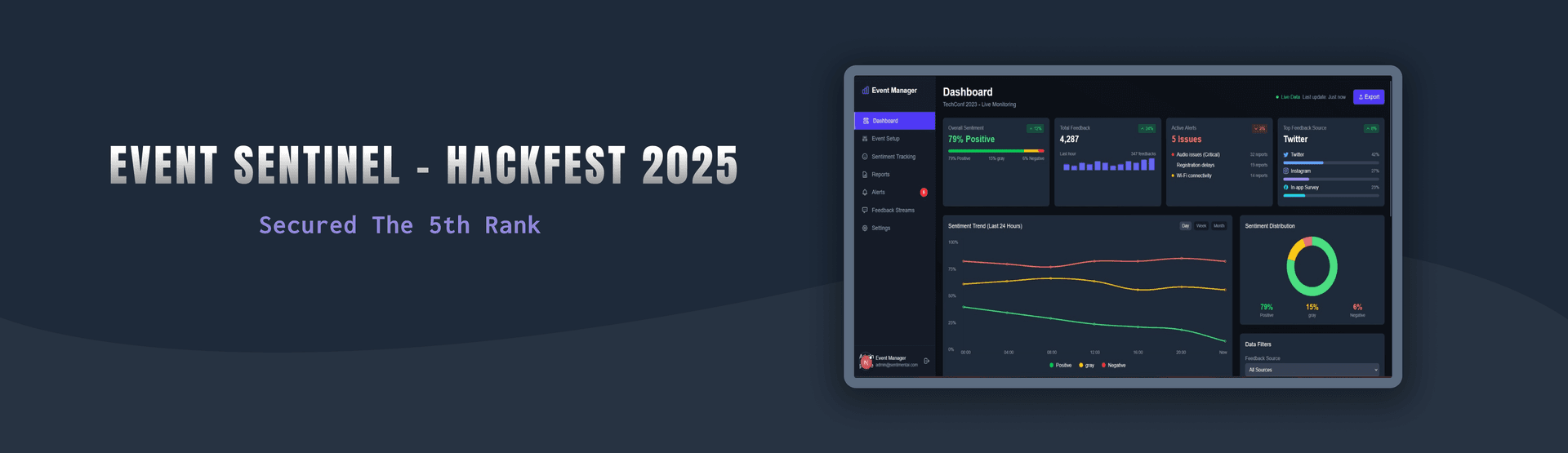
Event Sentinel – Hackfest 2025
Check it outA real-time, AI-driven event monitoring platform utilizing Kafka and RoBERTa to detect attendee sentiment shifts and crowd issues, securing 5th rank at Hackfest 2025.
Full-Stack Developer & AI Engineer
Hackfest 2025 (IIT ISM Dhanbad)
Overview
Event Sentinel is a real-time, AI-driven event monitoring platform developed for Hackfest 2025 at IIT ISM Dhanbad, where it secured the 5th rank. Designed to address the chaos of large-scale offline events, this solution empowers organizers to detect attendee issues, sentiment shifts, and crowd dynamics before they escalate. By centralizing live feedback from multiple digital channels and analyzing it using advanced NLP models, Event Sentinel ensures that every attendee concern is heard and resolved instantly.
Why We Built This
During high-energy events, attendee discomfort often gets lost in the noise. Our mission was to build a solution that allows organizers to respond to problems in real-time—not after the event is over. We created a system that listens to attendees, analyzes emotions using AI, and visualizes trends to help organizers stay ahead of potential issues.
Features
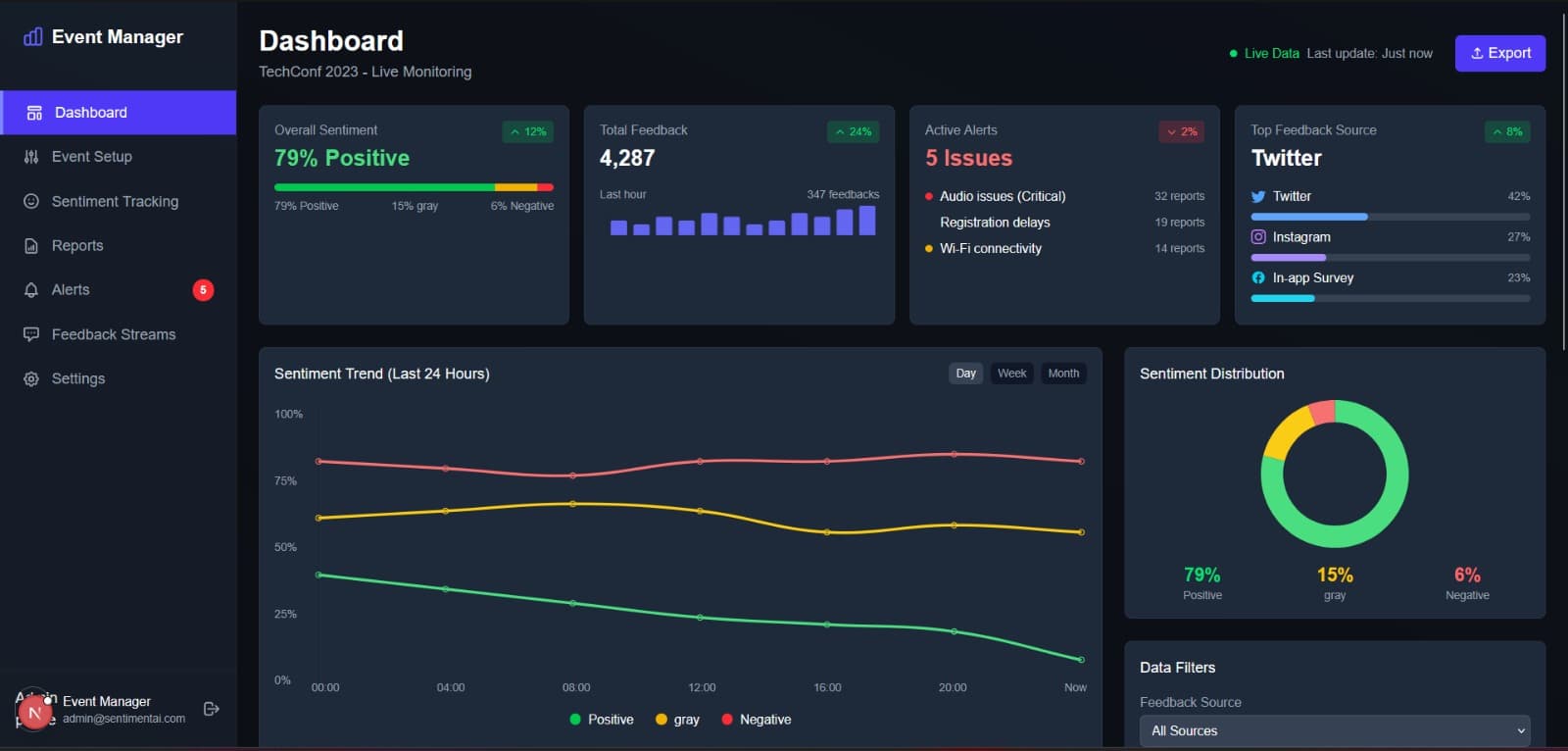
- Live Sentiment Aggregation: Real-time tracking of attendee emotions from event apps, Q&A platforms, and social media.
- Venue Heatmaps: Visualizes crowd density and discomfort zones across physical event locations.
- Automated Alerts: AI detects spikes in negative sentiment or crowd issues and triggers smart alerts.
- AI Chatbot + Feedback Loop: Offers attendees instant support and routes unresolved issues to the dashboard.
- Trend Spike Detector: Finds sudden increases in repeated keywords or concerns using spatiotemporal clustering.
Technology Used
- Frontend: Built with TypeScript, Next.js, React, and TailwindCSS for a responsive dashboard.
- Backend: Node.js and Express.js handling API logic, with MongoDB for data persistence.
- AI/ML: Python-based microservices using RoBERTa for sentiment classification and Scikit-learn for clustering.
- Real-Time Data: Apache Kafka and WebSockets for high-throughput data streaming and live updates.
- DevOps: Dockerized application deployed on AWS (S3) and Google Cloud Platform (GCP).
Machine Learning Modules
- RoBERTa-based Sentiment Classifier: Classifies sentiment into
Positive,Neutral, andNegativeusing a model fine-tuned on event feedback data. - Crowd Event Analyzer: Uses spatiotemporal clustering to detect localized issues at specific venue zones.
Design Screens

Challenges Faced
Integrating Python-based ML models with a Node.js backend via Kafka streams presented significant latency challenges. Additionally, ensuring the accuracy of sentiment analysis on informal, slang-heavy event text required extensive fine-tuning of the RoBERTa model.
What I Learned
This project solidified my understanding of Event-Driven Architecture using Kafka, the deployment of Microservices, and the integration of NLP models into a full-stack application. It also taught me how to architect a system that scales horizontally across different cloud providers (AWS & GCP).
Future Improvements
Plans include integrating CCTV feed analysis for computer vision-based crowd density estimation and expanding the chatbot capabilities with LLMs for more conversational support.
And more, including real-time predictive analytics and multi-event support.